Recruiter or employer
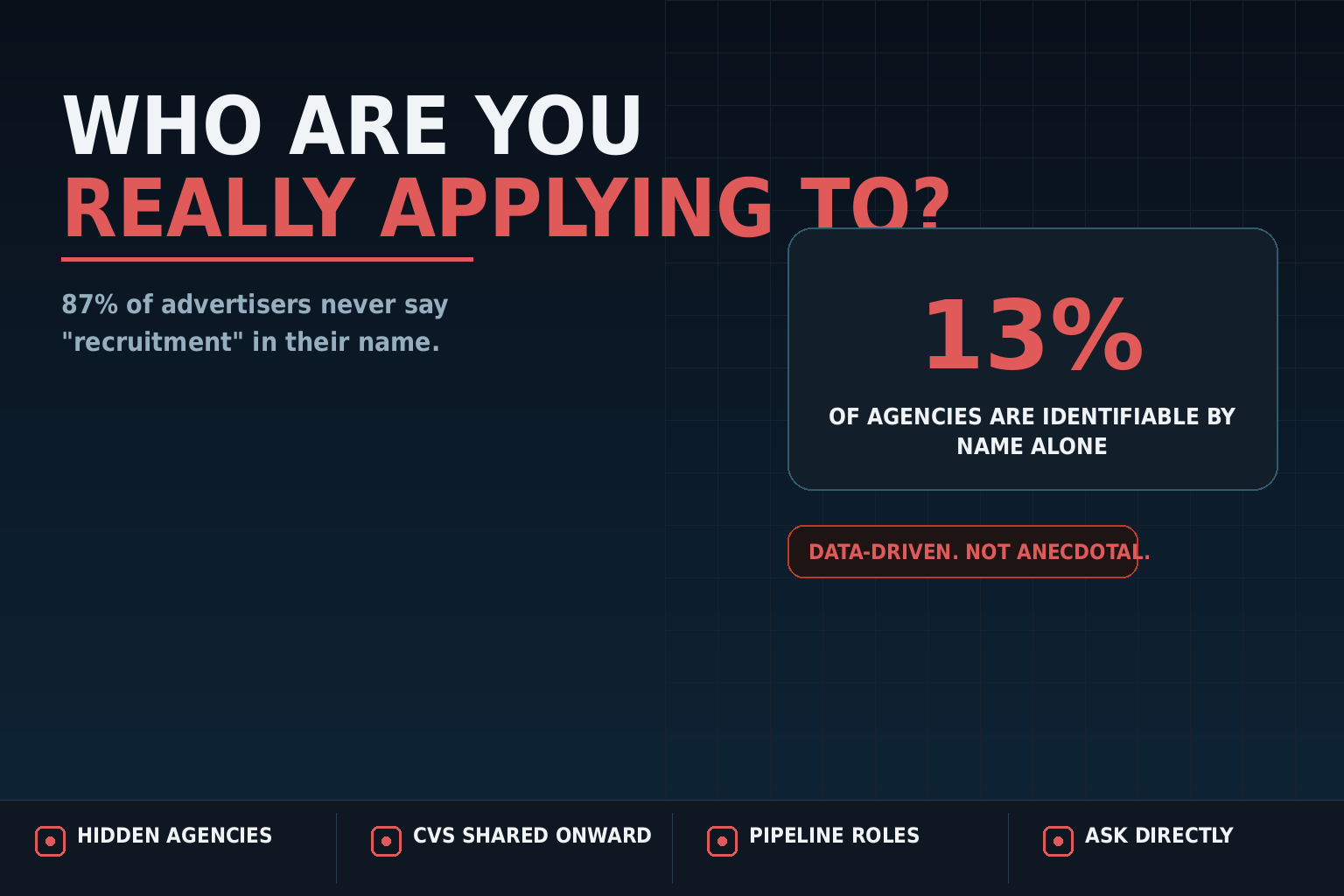
You think you're applying to a company. 87% of the time, you can't actually tell.
Recruiter or employer?
Why it's getting harder to tell — and why it matters.
Why it's not obvious anymore
In an analysis of over 35,000 distinct advertisers across UK job boards (246,000 postings total), the distribution is heavily skewed: 17,514 advertisers — about half — posted exactly once. At the other end, just 27 advertisers (0.08% of the total) posted 500+ times each, accounting for nearly 14% of everything on the boards we looked at. No single company, bar the very largest employers, has hundreds of live vacancies at once — that concentration is overwhelmingly a recruitment-agency signature, not an employer one.
🔎 Who actually decides?
With a recruiter, the person you're emailing usually isn't the hiring manager — decisions happen one step removed.
📤 Your CV may travel further
Recruiters often submit your details to the end client — sometimes to more than one — without always being upfront about it.
🎯 The role may not exist yet
Some agencies post variations of a generic role to build a candidate pipeline for whichever real vacancy comes in next.
🎯 A few practical checks
Search the company name plus "recruitment" or "staffing." Check whether the same advertiser posts wildly different role types across many industries and locations at once — a single employer rarely does that. And ask directly, early: "Is this role with your company or a client?" A legitimate recruiter will tell you plainly.
Recruiters aren't inherently a problem — many are excellent advocates who genuinely help candidates land roles. But knowing which kind of relationship you're in changes how you manage the process, what questions to ask, and how much to read into silence.
Know who you're really applying to
GetJobzi classifies advertisers as recruiter or employer automatically, so you don't have to guess.
👉 GetJobzi.com — Register for free